There are all sorts of ethical and environmental reasons to avoid seafood, but merely being conscious of the stench might be enough to put you off it for life. I can’t even walk into a seafood restaurant anymore without my stomach turning. A freshly-killed and gutted fish won’t have any smell at all, but fish decompose remarkably quickly and the smell associated with seafood is actually spoilage.
Apart from disgust, why do people abstain from seafood? The fishing industry wreaks havoc on the oceans, and most methods of catching fish are enormously cruel. On top of that, seafood is often contaminated with heavy metals and other substances that can harm your health. Let’s now take a deeper dive into all of this.
Fishing and Animal Cruelty
Convincing evidence demonstrates that fish can feel pain and even show fear. Most commercially caught fish die from suffocation. Fish caught in deep waters suffer the worst. When pulled to the surface, depressurization can pop out their eyes or burst their internal organs.
A fundamental concept of animal rights is “speciesism,” the unwarranted exclusion of certain animals from moral consideration. Humans commonly give preferential treatment to animals based on their appearance rather than their capacity to suffer. Of all animals killed for food, chickens and especially fish suffer disproportionately from speciesist thinking. Throughout its history, the animal protection movement has directed few resources towards advocating for these animals.
People exclude fish from moral consideration for a number of arbitrary reasons. The strongest of these may be that, because fish live underwater, we rarely see or think about them. Cold-blooded scaly animals with strange eyes don’t tend to evoke compassion from people.
Yet studies make clear that fish possess meaningful cognitive abilities and can even display empathy. What’s more, research into their neurological wiring confirms that fish feel pain. All of this has only come to light comparatively recently. No book systematically investigated this topic until the 2016 publication of Jonathan Balcombe’s What a Fish Knows. A 2017 study published in Nature indicates that fish rely on social interaction and community to deal with stressful occurrences.
Environmental Concerns
The purchase of seafood funds one of the planet’s most rapacious and environmentally devastating industries.
Fishing fleets pose grave threats to ocean ecosystems. Massive trawlers systematically and indiscriminately strip the oceans of sea life. According to the World Bank, “Almost 90 percent of global marine fish stocks are now fully exploited or overfished…”
What’s more, the seafood industry commits rampant fraud and deliberate mislabeling. A large meta-study conducted by Guardian Seascape in 2021, involving more than 9,000 seafood purchases from 30 different countries, identified 40 percent of samples as mislabeled. Further, the industry relies on a web of practices to evade catch limits. Widespread industry fraud means that consumers who pay a premium for “sustainable” seafood often still end up with fish taken from imperiled fisheries.
Everyone who eats fish should also know about by-catch. The term refers to the unwanted marine life who are netted or hooked, then typically thrown back into the water dead. By-catch is ubiquitous in the fishing industry, and its victims range from turtles to seabirds to porpoises. The shrimp industry can cause up to 20 pounds of by-catch for each pound of shrimp it nets. If you’ve heard of the term “dolphin-safe tuna,” it’s because dolphins commonly suffocate in nets cast into the sea by tuna boats. At least 4 million dolphins have drowned in these nets since the 1950s.
Fishing and Slavery
The fishing industry has a long history of human trafficking and slave labor, doubtless largely because it occurs on ships operating outside the governmental jurisdiction. Numerous exposés have revealed the plight of fishing boat workers, including these from The Guardian, The Conversation, and NPR.
Since governments seem powerless to address the issue, it’s up to you to take matters into your own hands by refusing to buy fish that is potentially caught using slave labor.
What About Farmed Fish?
Farmed fish are likely even less environmentally sustainable than wild-caught fish. That’s in large part because they’re typically fed with ground-up wild-caught fish.
Additionally, many farmed fish are genetically modified, their feed laced with high concentrations of antibiotics. Intensely crowded undersea cages enable opportunistic parasites like sea lice to thoroughly infest many fish farms. Genetically modified farmed fish routinely escape into the oceans, spreading disease and contaminating the gene pools of native species—14,000 GMO salmon escaped in 2024 at a Norwegian fish farm. The next year, at another Norwegian facility owned by the same company, 15,000 more GMO salmon escaped.
Contamination & Toxicity Risks
Eating fish of any sort creates worrisome health risks. Large carnivorous fish species like tuna and swordfish invariably contain high levels of mercury—a heavy metal detrimental to brain function and fetal development. Any form of mercury is bad news, but the methylated mercury present in seafood is especially toxic. According to the EPA: “Nearly all methylmercury exposures in the United States occur through eating fish and shellfish that contain higher levels of methylmercury.”
As the world’s oceans become increasingly polluted, eating fish becomes fraught with ever-increasing health concerns. A January 2017 article in The Telegraph began:
Seafood eaters ingest up to 11,000 tiny pieces of plastic every year with dozens of particles becoming embedded in tissues, scientists have warned, in findings described as ‘sobering’ by the Prince of Wales.
Given the massive volume of plastic dumped daily into our oceans—about eight million metric tons a year—risks tied to microplastics in seafood will inevitably grow.
Omega-3 Fatty Acids
Eating fish from cold ocean waters does offer one irrefutable benefit: these fish contain substantial amounts of omega-3s, DHA, and EPA. These fat molecules are all associated with better brain health.
Fortunately, there are rich vegan sources of these fats. Chia seeds, flax seeds, and walnuts are all excellent sources of omega-3s. You can therefore improve your omega-3 status on the cheap by incorporating any of these foods into your daily diet. Chia seeds are great in cereal, mixed into soy milk, or used as an egg-replacer. Just a couple of teaspoons a day can boost your omega-3 intake to levels that experts recommend.
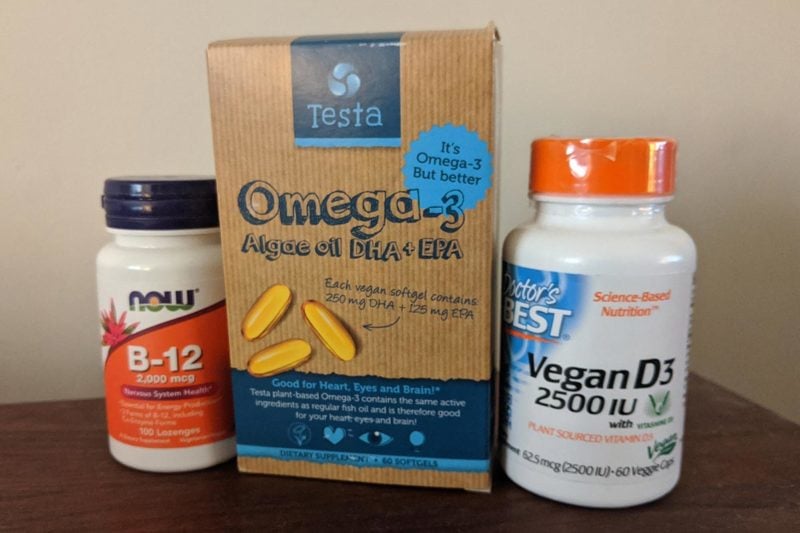
Your body can convert the omega-3 fats you consume into DHA and EPA, two important brain nutrients. But people vary widely in their ability to create DHA and EPA from omega-3, so you may want to supplement. Not so long ago, fish products were the only reliable source of DHA and EPA. Fortunately, you can now purchase vegan DHA/EPA supplements that are made from algae rather than fish. What’s more, these supplements are much less likely than fish-derived supplements to contain appreciable amounts of mercury, plastics, and other contaminants. Three popular vegan brands are DEVA, Amala Vegan and Ovega-3.
If you do take a DHA and EPA supplement, you should still consume chia, flax, or walnuts daily. It’s important to get the alpha-linolenic acid (ALA) fats these foods contain, and very few other vegan foods contain these fats in significant amounts.
Vegan Fish Alternatives & Recipes
Ridding your diet of seafood is easier than ever before. Take a look at these excellent vegan seafood alternatives:
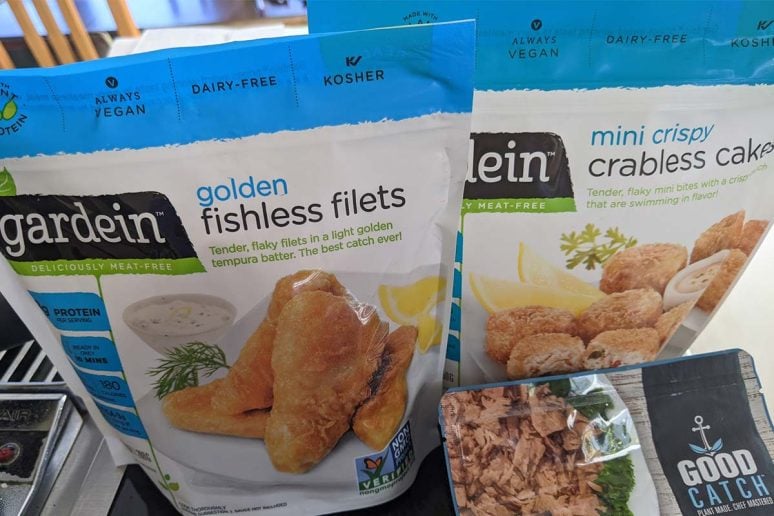
- Gardein: Plant-Based F’sh Filet and Mini Cr’b Cakes
- New/School Foods: Salmon (only distributed to restaurants)
- PLNT: Fish Fingers and Salmon Fillet (Europe only)
- Squeaky Bean: Vegan Smoked Salmon Slices (UK)
- Unmeat: Tuna in Water
- Upton’s Naturals: Banana Blossom (requires making your own batter and frying)
- Vegan Zeastar: Sashimi, Shrimp, Cod, Tuna, King Crab. (Mostly European distribution)
Want a cookbook entirely devoted to vegan seafood recipes? Pick up a copy of Everything That Used To Have Fish is Now Vegan.
Your choice of vegan fish alternatives will only improve over the coming years. Expect the next generation of vegan fish products, based on microalgae, to offer compelling nutritional advantages.